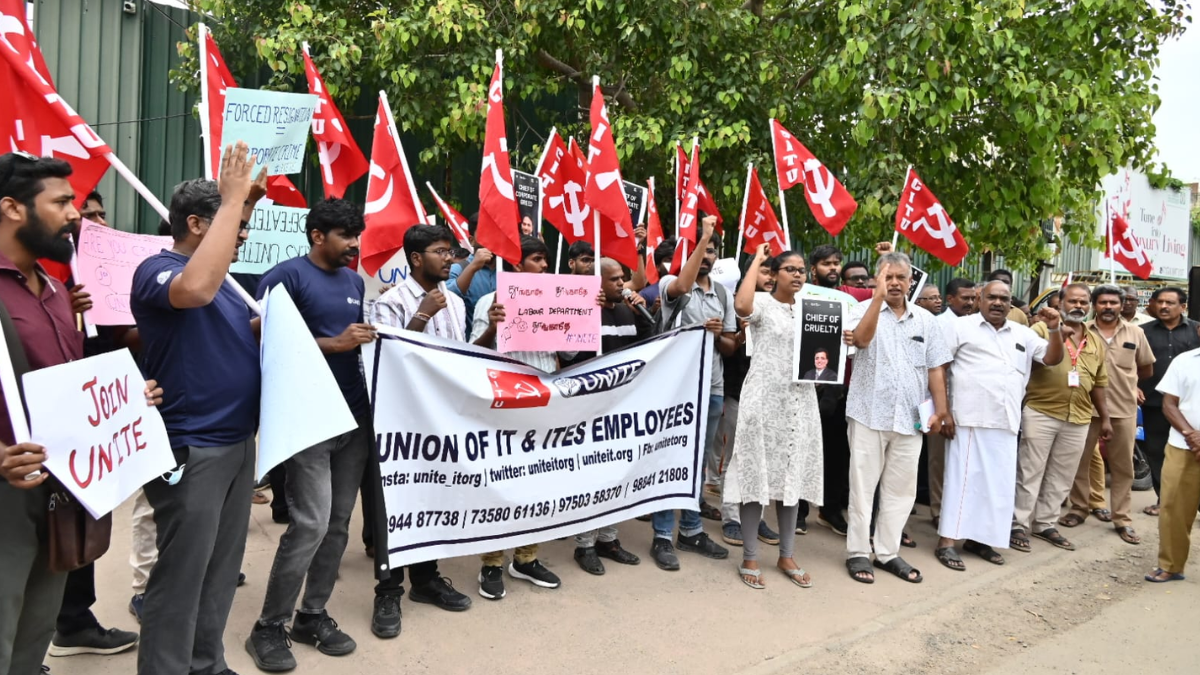
CHENNAI, INDIA – A storm of protest has erupted outside the offices of Tata Consultancy Services (TCS), India’s largest IT services firm, as employees and union members demand answers following widespread reports of massive layoffs. The situation, unfolding primarily in Chennai, has sent shockwaves through the Indian technology sector, with a workers’ union making the staggering claim that up to 40,000 employees have been let go.
The protests highlight the growing anxiety within the multi-million strong Indian IT workforce, often seen as a bellwether for the global technology services industry. This article breaks down the conflicting narratives, the union’s allegations, the company’s official response, and the broader context of these dramatic events.
The Epicenter of the Protest: What is Happening on the Ground?
The tension became visibly public on Wednesday, as groups of protestors, organized by the Union for IT and ITES Employees (UNITE), gathered outside TCS’s facilities in the Sholinganallur area of Chennai—a key IT hub in the city. Security was heightened as demonstrators held placards and raised slogans against the company’s alleged decision to terminate a huge number of employees without what they claim is proper due process.
The mood on the ground is one of frustration and uncertainty. While the exact number of protesting individuals varies, the presence of a formal union leading the charge marks a significant moment in the typically less-unionized Indian IT landscape.
The Union’s Explosive Allegations: 30,000 to 40,000 Jobs Lost
At the heart of the controversy are the figures presented by UNITE. The union has been vocal in its claims, stating that the layoffs are not performance-based but a large-scale structural decision by TCS management.
Speaking to the media, a union representative stated, “We estimate that between 30,000 to 40,000 employees have been asked to leave TCS in recent weeks. This isn’t just about performance. It’s a massive cost-cutting exercise disguised as a routine annual process. Experienced employees with higher salaries are being targeted, which is a clear violation of the principles of fair workplace practices.”
The union has further alleged that the process has been abrupt, with many employees receiving termination notices with very short severance packages, often tied to their notice period, and being asked to resign rather than being formally laid off. This, they argue, prevents employees from accessing better termination benefits and masks the true scale of the action in official records.
Furthermore, UNITE has announced plans to escalate the issue beyond Chennai. They are reportedly mobilizing support from international worker alliances and planning a “global day of action” to bring worldwide attention to the treatment of TCS employees.
TCS’s Firm Rebuttal: Company Calls Reports “Misleading and Baseless”
In response to the growing media frenzy and protest action, Tata Consultancy Services has issued an official statement vehemently denying the scale and nature of the layoffs as described by the union.
The company maintains that what is being portrayed as mass layoffs is merely part of its “annual performance review process.” A TCS spokesperson clarified that this is a routine exercise conducted every year to manage workforce performance and efficiency.
“Like any performance-driven organization, we have a periodic performance review process where certain underperformers are advised to seek opportunities outside the company. This is a regular annual exercise and the numbers being quoted by certain quarters are simply misleading and baseless,” the company stated.
TCS has emphasized that its attrition rate remains low and that it continues to be a net hirer of talent. The company pointed to its recent hiring figures and onboarding of new graduates as evidence that there is no large-scale reduction in its workforce strategy. They attribute the current situation to misinformation and fear-mongering being spread by external agencies.
A Clash of Narratives: Performance Management or Mass Layoffs?
This conflicting narrative creates a complex picture. The Indian IT industry has always had a “bell curve” system of annual appraisals where a certain percentage of low performers are managed out of the organization. However, the scale alleged by the union—40,000 employees—would represent a significant portion of TCS’s vast workforce, which numbers over 600,000 people globally.
Industry analysts are divided. Some suggest that the post-pandemic era, combined with global macroeconomic pressures and a slowdown in client spending, is forcing Indian IT giants to look closely at their cost structures. This could lead to more rigorous performance management and a focus on utilising cheaper, fresher talent.
Others argue that for a company of TCS’s size and profitability, letting go of even 30,000 employees over a year through its regular process might be within the statistical norm of annual attrition and performance management, though the timing and concentration of these exits are what have sparked the outrage.
The Bigger Picture: Industry-Wide Trends and Global Pressures
The protests at TCS do not exist in a vacuum. They reflect a broader trend of uncertainty in the global tech sector. In recent months, other tech giants, from startups to behemoths like Oracle, have also undertaken restructuring exercises leading to job cuts.
Several factors are at play:
- Global Economic Headwinds: Clients in key markets like the US and Europe are tightening budgets, delaying new projects, and demanding greater efficiency for their existing IT spending.
- Rapid Technological Shift: The focus is sharply moving towards generative AI, cloud computing, and automation. Companies are likely reskilling their workforce, and some roles may become redundant in the process.
- Margin Pressures: To protect their profitability, IT firms are under constant pressure to optimize operational costs, and employee cost is the single largest component.
The TCS incident is being closely watched by every other major IT firm in India, including Infosys, Wipro, and HCL Technologies, as it could set a precedent for how such large-scale workforce management is handled in the future, both legally and in the court of public opinion.
What’s Next? Legal Challenges and Global Action
The Union for IT and ITES Employees (UNITE) has made it clear that they will not back down. They have promised to provide legal aid to affected employees and are exploring challenges in court. They argue that the terminations violate the conditions of the Industrial Disputes Act, especially if the scale is as large as they claim.
Their planned “global day of action” aims to leverage international pressure on the Tata Group, a conglomerate with a proud reputation for ethical business practices. How TCS navigates this dual challenge of managing its business imperatives while upholding its brand image will be critical in the coming weeks.