The Sky Was Never the Limit: Subhanshu Shukla’s Historic Leap into Space
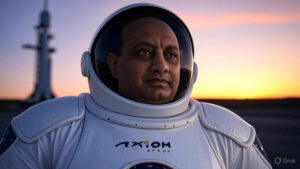
On June 25, 2025, history etched a new name in the stars: Subhanshu Shukla, India’s first private astronaut, soared into orbit aboard Axiom Mission 4 (Ax-4). As the SpaceX Falcon 9 rocket tore through the Florida sky, Shukla shattered ceilings—not just for India, but for the future of commercial spaceflight. This mission marks a seismic shift in who accesses space, and Shukla—a former Indian Air Force pilot turned aerospace engineer—is its pioneering face.
Who Is Subhanshu Shukla? From Fighter Jets to the Final Frontier
(Image Prompt: Split-image: Young Shukla in IAF uniform next to a Tejas fighter jet vs. current Shukla in astronaut gear. Earth visible through a window behind him.)
Born in Lucknow, Shukla’s trajectory was written in the clouds. After graduating from the National Defence Academy, he flew fighter jets with the Indian Air Force for 13 years, logging 2,500+ flight hours. But his eyes lingered beyond Earth’s atmosphere. Post-IAF, he joined a private aerospace firm as a systems engineer and test pilot, specializing in spacecraft safety protocols—a niche expertise that caught Axiom Space’s attention.
“Space isn’t just for governments anymore. It’s for dreamers with grit,” Shukla stated in a pre-launch interview.
Axiom Mission 4: Why This Mission Changes Everything

Ax-4 isn’t just another ISS trip. It’s a landmark in the $1.5B private spaceflight market, proving commercial missions can drive science and accessibility. Led by veteran NASA astronaut Peggy Whitson, the 10-day mission focuses on:
-
Microgravity research (cancer cell studies and material science)
-
Technology demonstrations for future lunar habitats
-
Global outreach, with Shukla representing India’s rising space economy
Shukla’s role? Payload Operations Lead, managing experiments critical for NASA’s Artemis goals. His salary—rumored at $5-7 million—reflects the premium on private astronaut expertise (Source: Jagran Business).
The Launch Heard ‘Round the World

At 11:15 PM IST on June 25, Ax-4 launched from NASA’s Kennedy Space Center. Millions watched live as Shukla waved from the Dragon capsule—India’s first astronaut since Rakesh Sharma (1984). Unlike ISRO’s Gaganyaan program (targeting 2025), Shukla’s flight underscores how private partnerships accelerate access.
“This democratizes space,” said Axiom CEO Michael Suffredini. “Talent like Shukla’s isn’t bound by borders.”
Training: Where Grit Meets Zero-G
Shukla’s 18-month regimen included:
-
Survival training in harsh Russian winters
-
Centrifuge runs at 8G forces
-
Emergency drills in SpaceX simulators
-
Robotics operations for ISS experiments
His IAF background proved vital. “Fighter pilots process chaos calmly. That’s gold in space,” noted Whitson.
Why This Matters for India and Beyond
Shukla’s mission turbocharges India’s space ambitions:
-
Private Sector Surge: Startups like Agnikul and Skyroot gain validation.
-
STEM Surge: 400% spike in Indian aerospace engineering applications since 2023.
-
Economic Lift: India’s space economy could hit $13B by 2030 (Source: NASA Commercial Space).
The Future: Moon, Mars, and More
Axiom plans its own space station by 2028, where Shukla may return as commander. Meanwhile, India’s ISRO eyes Venus missions and crewed launches.
“Shukla’s flight is a down payment on interplanetary civilization,” says SpaceX’s Elon Musk.
Conclusion: One Giant Leap for Dreamers
Shubhanshu Shukla didn’t just cross the Kármán line—he rewrote its meaning. In an era where space is no longer monopolized by superpowers, his journey screams: The stars belong to the persistent. As Ax-4 orbits Earth today, it carries a message for every child in Mumbai or Meerut: Your sky is limitless.