
I need to confess something. As a political commentator, I spend a lot of time watching the digital discourse. And recently, I’ve been fascinated by a specific, brutally straightforward search trend: “idiot Donald Trump.“ It’s not just a muttered insult; it’s a global query, a meme, and a political weapon all rolled into one.
But here’s what I’ve learned: when a phrase reaches this level of viral saturation, it’s no longer just an insult. It becomes a Rorschach test. For some, it’s a perfect summary of their feelings. For others, it’s evidence of a biased world. My job today isn’t to simply echo the label, but to pull back the curtain. I want to explore the specific incidents, the international perspectives, and the technological quirks that fuel this phenomenon. Let’s dive into what people are really talking about when they type those three words.
Deconstructing the Label: When “Idiot” Becomes a Political Argument
Calling a world leader an “idiot” is, on its face, childish. But in politics, insults often serve as shorthand for more complex criticisms. When commentators use this term about Donald Trump, they’re typically pointing to a pattern of behavior, not a single IQ test. Based on my research, the argument rests on three primary pillars.
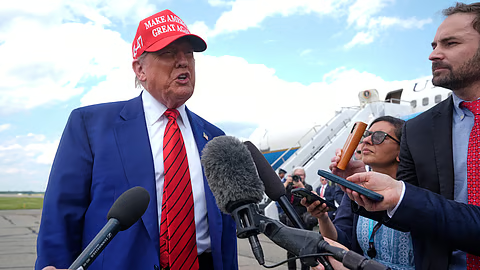
The “Unscripted Trump”: A Case Study in Off-the-Cuff Rhetoric
I’ve analyzed countless speeches and interviews, and the divergence between Trump’s scripted and unscripted moments is stark. Critics point to his rambling, often contradictory extemporaneous speeches as evidence of a scattered thought process.
A recent, high-profile example comes from Michael Wolff’s reporting. Wolff, who spent significant time with Trump for his books, describes a scene where Trump allegedly struggles with basic concepts presented to him by his own aides. The claim isn’t just that he’s uninformed, but that he actively resists engaging with complex briefings, preferring intuitive, gut-level decisions. Whether you trust Wolff’s account or not, it encapsulates the core of this criticism: a perceived disdain for the nuanced, detailed work of governance.
The Geopolitical “Useful Idiot” Theory
This is where the critique moves from domestic mockery to a grave international security concern. The term “useful idiot” has a long, dark history in Cold War politics. It refers to a person whose naïve allegiance to a cause (in this case, a Western leader’s sympathy for Russia) is exploited by a hostile foreign power.
As commentary in The Japan Times highlighted, many global security experts view Trump’s repeated praise of Vladimir Putin through this lens. The argument goes like this: by consistently undermining NATO