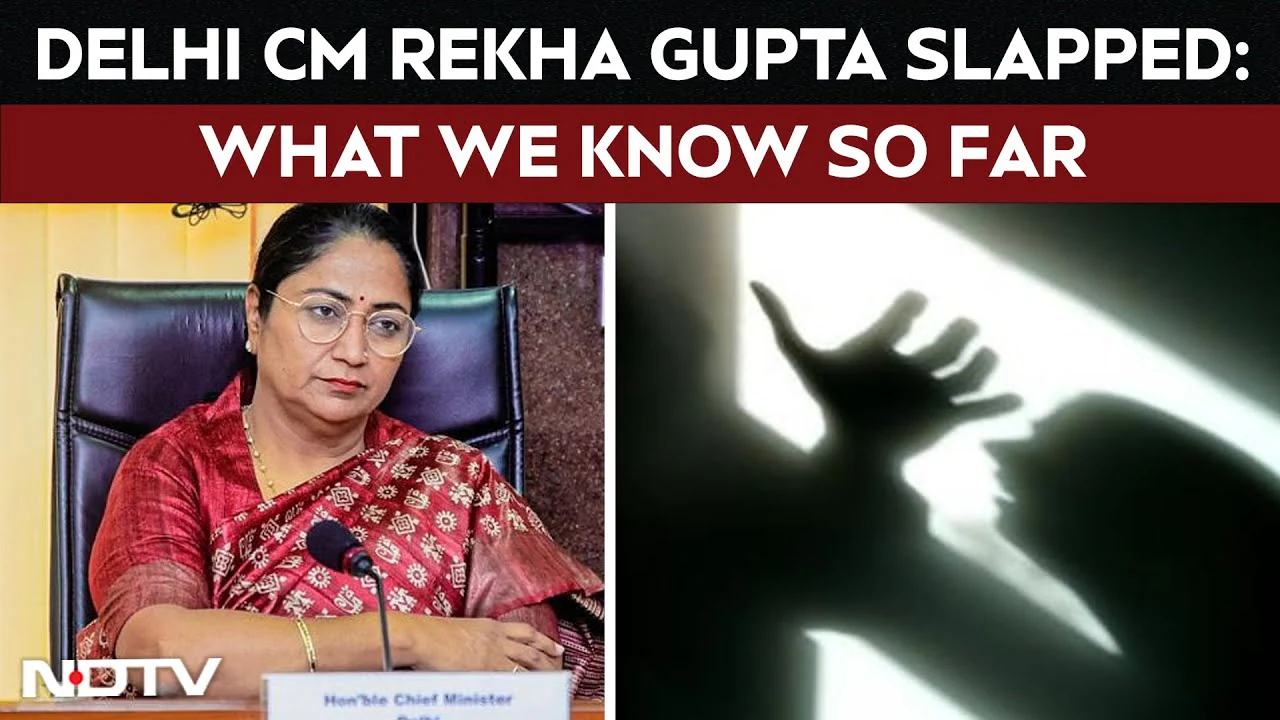
CM Rekha Gupta In a shocking incident that has sent ripples across the Indian political landscape, Delhi Chief Minister Rekha Gupta was assaulted during a public grievance hearing on Tuesday. The Chief Minister was reportedly slapped by a man who had infiltrated the ‘Jan Sunvai’ (public hearing) event, leading to immediate chaos and her swift evacuation by security personnel. The attacker was promptly overpowered and arrested on the spot.
This brazen act of violence against a sitting Chief Minister has sparked nationwide condemnation, raised serious questions about the security protocol for high-profile leaders, and ignited a fierce political blame game.
The Incident: A Minute-by-Minute Account of the Attack
The event was a routine ‘Jan Sunvai,’ a platform where citizens meet the CM to voice their grievances. It was being held at the Delhi Secretariat and was reportedly attended by dozens of people.
According to eyewitness accounts and police reports, the sequence of events unfolded as follows:
- Approach: The alleged assailant, identified as Ankit Sharma, joined the queue of attendees waiting to meet the CM. He was dressed in ordinary clothes and did not initially raise any suspicion.
- The Assault: As he reached the table where CM Gupta was seated, listening to a petitioner, he suddenly lunged forward. Instead of presenting a petition, he slapped the Chief Minister across the face. The attack was swift and caught everyone, including the close-protection security detail, by surprise.
- Immediate Response: For a split second, there was stunned silence, which was quickly broken by shouts and commotion. The Chief Minister’s personal security officers (PSOs) and other staff present at the venue immediately rushed forward.
- Apprehension: The man was violently tackled to the ground by a swarm of security personnel and police officers. He was subdued, pinned down, and handcuffed within moments of the attack. Videos from the scene show a chaotic scuffle as officials scrambled to secure the area.
Who is the Attacker? Preliminary Findings on Ankit Sharma
The Delhi Police, While the exact motive is still under investigation, early reports from police sources indicate that Sharma may have been harboring a personal grievance related to a civil matter. He allegedly believed his issue had not been addressed adequately by the administration, leading to a build-up of frustration. However, authorities are exploring all angles, including the possibility of a deeper conspiracy or mental health issues. He has been booked under relevant sections of the Indian Penal Code for assaulting a public servant to deter them from discharging their duty and other stringent charges.
Political Firestorm: Condemnation and Accusations Fly
As news of the attack spread, it triggered an immediate and intense political reaction.
- Widespread Condemnation: Leaders from across the political spectrum, including the Prime Minister’s Office, put out statements condemning the attack. The President of India and Vice President are also reported to have called CM Gupta to express their concern and condemn the act of violence. The National Commission for Women has taken suo motu cognizance of the incident.
- The BJP’s Allegation: The Bharatiya Janata Party (BJP), the main opposition party in Delhi, was quick to condemn the physical attack. However, senior BJP leaders also launched a pointed criticism of the Aam Aadmi Party (AAP) government. They alleged that the ruling party routinely stages “dramas” and “scripted events” for political gain. Without providing concrete evidence, they insinuated that the incident needed to be thoroughly probed for authenticity, a claim that was immediately dismissed by the AAP as “insensitive and baseless.”
- AAP’s Rebuttal: The Aam Aadmi Party hit back fiercely, labeling the attack as a symptom of a degrading political discourse encouraged by the BJP’s rhetoric. Senior AAP leaders accused the BJP of trying to deflect from the core issue—the security lapse and the act of violence itself. They demanded an apology for the BJP’s “irresponsible statements.”
This political slugfest, while expected, has overshadowed the initial narrative of unanimous condemnation, turning the incident into a partisan issue.
The Glaring Security Lapse: How Did This Happen?
The most pressing question emerging from this incident is: How did a individual manage to breach multiple layers of security to physically assault a sitting Chief Minister?
Chief Ministers are designated Z-plus or Y-plus category protectees, entailing a multi-layered security cordon comprising armed commandos from the Central Armed Police Forces (CAPF) and local police. A ‘Jan Sunvai’, by its very nature, is a high-risk event as it involves close proximity between the public and the VIP.
- Pre-event verification: Attendees are often pre-registered and their details screened.
- Physical frisking: Everyone entering the hall is supposed to be thoroughly frisked by metal detectors and security personnel.
- Controlled approach: There is usually a barrier or a table maintaining a safe distance between the public and the VIP. PSOs are trained to be within an arm’s length to intercept any sudden movement.
The fact that Ankit Sharma could get close enough to slap the CM suggests a failure in one or more of these protocols. The Delhi Police has already ordered an internal inquiry to identify the lapses and fix responsibility.
Beyond the Slap: A Sobering Look at the Safety of Public Representatives
The attack on CM Rekha Gupta is not an isolated event. It reflects a disturbing trend of increasing aggression and violence towards public figures and officials. From members of parliament to local councilors and bureaucrats, many face threats, abuse, and even physical harm.